
JCPenney didn’t lose $12 billion because Americans suddenly stopped shopping
By: Editmybrand · Forensic Brand Strategy. UNSEEN BILLIONS™

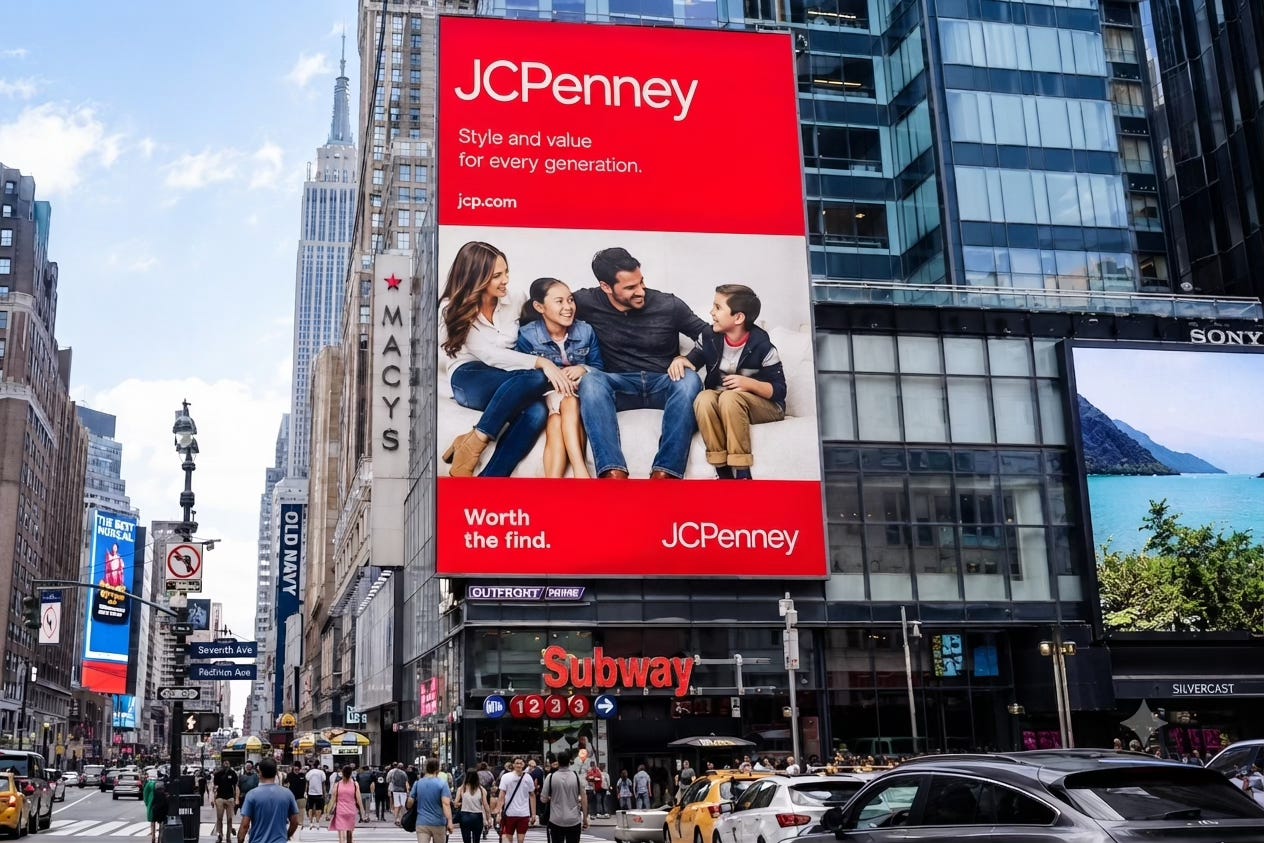
I don’t know a single person who’d pick JCPenney for back-to-school shopping. Not one. And I don’t say that to be mean. I say it because when a brand becomes irrelevant, that’s the tell, not the mall traffic numbers, not the earnings call, the fact that nobody even considers you anymore.
I’m a millennial. There was a time girls my age went to the mall for fun. Not to buy anything specific. Just to be there. That was the whole plan for a Saturday. Every American sitcom I grew up watching in Sweden was built around that same backdrop, a food court, a fountain, a department store anchoring the whole thing together. JCPenney was supposed to be part of that. It wasn’t the exciting store. It was the reliable one, the one your mom trusted, the one that was just always there.
Walk into a JCPenney today and it still feels stuck somewhere around 2010, Katy Perry’s “Teenage Dream” playing in the background, the clothes, the layout, the whole experience frozen in a decade everyone else has moved past. Compare that to what’s actually competing for the same shopper’s money now, and it’s not close. The department store format itself looks old-fashioned next to what the rest of retail is offering.
Here’s what I want to be clear about before I go one sentence further: this is not another “malls died in 2008” story. Malls did decline. That’s real. But that explanation is too easy, and it lets everyone who actually ran this company off the hook. JCPenney’s problem isn’t that shopping moved online. It’s a governance problem, meaning the people running the company kept making bad calls, for over a decade. This autopsy opens that up.
Here’s the whole point of this piece, in one sentence, before you read anything else: JCPenney got hurt twice by the people who were supposed to save it. First, an investor and the CEO he picked broke something that was actually working. Second, the company’s own landlords, the people it was already paying rent to every month, bought the company and turned it into a way to keep paying themselves, no matter whether the stores ever get better.
A quick word first: you’ll see a few business words in this piece, like “landlord,” “bankruptcy,” “board of directors,” and “royalties.” A landlord is whoever owns the building you’re renting. Bankruptcy is what happens when a company owes more money than it has, and a court has to sort out what happens next. A board of directors is a small group of people who aren’t employees but who oversee the CEO and make the biggest decisions. Royalties are fees you pay someone for the right to use something they own, like a name. Keep those four in your head, the whole story is built out of them.
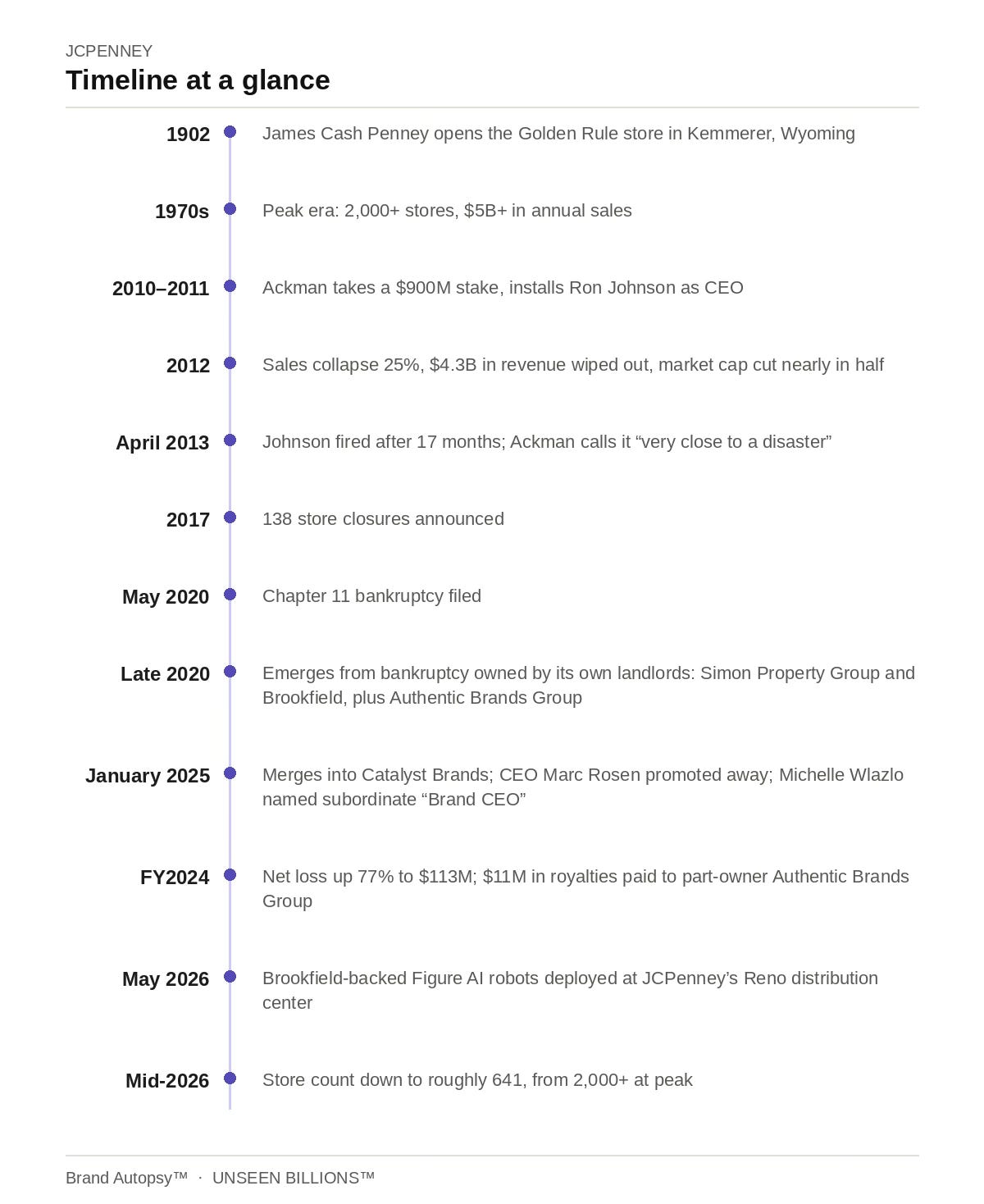
Every one of those dates gets its own full treatment below. This is the order it actually happened in.
The numbers
Before the history, the cost, because “how much did JCPenney lose” needs a real number attached, not a vibe.
The store count: from over 2,000 to 641. At its peak in the 1970s, JCPenney operated more than 2,000 stores nationwide. By early 2020, before its bankruptcy, that number was already down to 846. As of mid-2026, it’s roughly 641.
The Ron Johnson number: $4.3 billion in lost revenue, and a market cap cut in half. Ron Johnson killed JCPenney’s momentum in 17 months. He gutted the sales and coupons model his customers were built around, replacing it with an untested “everyday low price” strategy he never even piloted. Sales fell 25% in a single year, wiping out $4.3 billion in revenue. Shareholders watched the market cap fall from $6.84 billion to $3.49 billion. That’s not strategy. That’s sabotage. Employment fell from 150,000 to 116,000 in the same stretch.
The extraction number: $11 million a year, and counting. In fiscal 2024, JCPenney paid $11 million in royalty and related payments to Authentic Brands Group, one of its own part-owners. That’s on top of rent paid to Simon Property Group and Brookfield, JCPenney’s landlords and, since 2020, its owners too.
The automation number: $1 billion. That’s how much Brookfield put into Figure AI’s Series C round, the humanoid robotics company Catalyst Brands (JCPenney’s parent) hired in May 2026 to automate its Reno distribution center, in the same fiscal year JCPenney’s own net loss grew 77%.
Put it together: a company that once had over 2,000 stores has 641 left, one CEO era alone cost it a billion dollars and half its workforce’s confidence, and its current owners are collecting rent and royalties from it while investing in the robots that replace its own labor.
Who Is James Cash Penney?
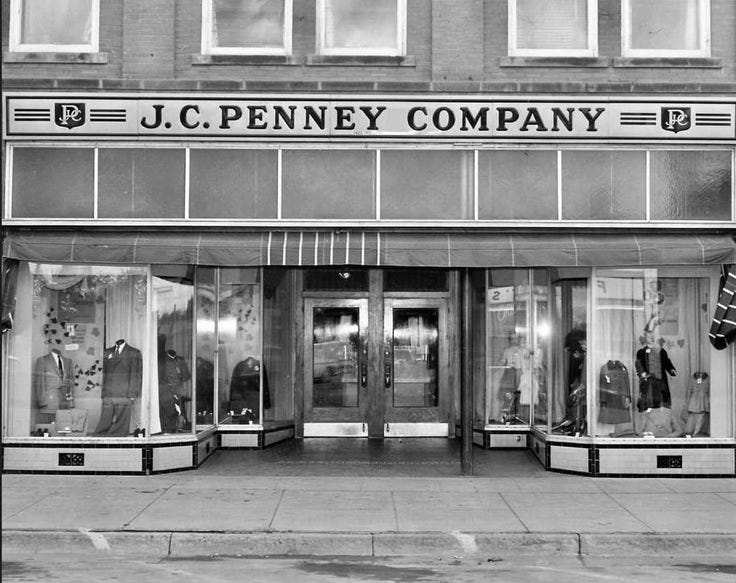
JCPenney started with a one-third partnership and $2,000. In 1902, James Cash Penney, the son of a Missouri preacher, took that stake from his employers Guy Johnson and Thomas Callahan and opened a Golden Rule dry goods store in Kemmerer, Wyoming, a coal mining town of about 1,000 people.
Here’s what that actually meant at the time, and why the name wasn’t just branding. Kemmerer’s mining company paid its workers partly in scrip, credit that could only be spent at the mining company’s own store, at whatever prices the company decided to charge. Miners weren’t really customers there. They were captive. A local banker warned Penney that opening a cash-only store in that town was a fool’s errand, three others had already tried it and failed, since there simply wasn’t enough real cash in the local economy to support one. Penney did it anyway. His store charged the same fixed price to everyone, refused to sell on credit, and only took real cash, no scrip, no haggling, no different price depending on who you were or how you were dressed. For miners who’d only ever had one place to shop and no say in what it charged them, that was the first real choice they’d had. He named the store after a principle, not a person: treat every customer the way you’d want to be treated yourself. By 1907 he’d bought out his original partners. By 1913, the company carried his own name.
That principle, an actual, structural choice to not exploit the only leverage the store had over its customers, is what carried JCPenney through the twentieth century. It went public in 1929. It survived the Depression. It opened its first true department store in 1961, moving beyond dry goods into the full mall-anchor format most people actually remember. By the 1970s, it had more than 2,000 stores and over $5 billion in annual sales. For decades, JCPenney wasn’t the exciting store in the mall. It was the dependable one. That reputation didn’t come from a slogan. It came from a store that once had every reason to overcharge a captive audience and chose not to. That was the entire brand.
What Happened Between the Peak and Ackman
Here’s the short version of the 40 years this piece jumps over, because JCPenney wasn’t a healthy company that suddenly broke in 2010. It was already tired.
In the 1970s, cheaper stores like Walmart started opening, and JCPenney got stuck in the middle, not the cheapest, not the fanciest. In the 1980s, they reinvented themselves as a clothing and home store and moved their headquarters to Texas to save money. In the 1990s, they leaned on side businesses, drugstores, a catalog, to prop things up while the main stores kept getting weaker. By 2000, the company was in real trouble: profits down 43% in a single year. They brought in an outside CEO for the first time in the company’s 99-year history, closed 48 stores, and still lost $705 million that year. He actually turned it around for a few years. Then the 2008 financial crash hit every department store, JCPenney included, and knocked it right back down.
So when Ackman showed up in 2010, he wasn’t attacking a strong company. He was buying into one that had already been weakened once, patched up once, and weakened again. That matters, because it means what happened next wasn’t really new. It was the same pattern showing up again, just with different people doing it
The First Time JCPenney Almost Died
Most retrospectives skip straight to the 2020 bankruptcy. That’s a mistake, because JCPenney already had a near-death experience seven years earlier, and the way it played out tells you almost everything about how the second one would happen too.
In 2010, hedge fund manager Bill Ackman’s Pershing Square Capital took a $900 million stake in JCPenney, about 17.8% of the company, and Ackman joined the board. In 2011, Ackman recruited Ron Johnson, the executive credited with building Apple’s retail stores and Target’s design-forward image, to become JCPenney’s CEO. Johnson was paid $53.3 million in his first year.
Johnson’s plan was to kill the thing JCPenney’s customers actually relied on: sales and coupons. He replaced them with an untested “everyday low price” model, reportedly telling colleagues “we didn’t test at Apple” when asked why the new pricing wasn’t piloted first. In 2011, the same year Johnson arrived, Ackman also orchestrated a $900 million stock buyback, cash that pushed the share price up in the short term and that JCPenney would badly need two years later.
The results were immediate and brutal. Sales fell 25% in 2012 alone, wiping out $4.3 billion in revenue. The stock fell from where it stood when Johnson took over, and the market cap dropped from $6.84 billion to $3.49 billion. Employment fell from 150,000 people to 116,000. Older, loyal customers, the ones the “everyday low price” strategy had alienated, took their business to Sears and Kohl’s instead. This wasn’t a strategy that failed to land. It was a strategy that dismantled the one thing JCPenney’s customer base was actually loyal to, and never replaced it with anything they wanted instead.
In April 2013, after just 17 months, the board fired Johnson. Ackman himself, the man who’d handpicked him, told investors the turnaround had been “something very close to a disaster.” Former CEO Myron Ullman was rehired to clean it up.
It’s worth being precise about what Ackman actually got wrong. He wasn’t wrong that JCPenney was decaying, the sales-and-coupons model really was outdated, and a company that size really did need to change. He was wrong about which asset actually mattered. He treated JCPenney’s problem as a format problem, the stores looked old, the pricing looked dated, so he installed an executive to redesign the format. But JCPenney’s real asset was never the format. It was customer trust, decades of it, built on a promise of reliability. Johnson’s reinvention didn’t modernize that trust. It spent it, in 17 months, without ever asking whether the customer wanted what he was building.
Here’s the pattern worth naming before we move on: an outside financial player took a large stake, installed a leader with no accountability to the culture he was reinventing, extracted cash through a buyback at the exact moment the company needed it most, and left when the damage was done. JCPenney survived that round bruised, with a workforce that had shrunk by nearly a quarter and a brand that had just told its most loyal customers it didn’t want their coupons. It would not get another decade before the second version of this story began.
The Slow Bleed, 2013 to 2020
JCPenney spent the years after Johnson’s ouster trying to win back the customers his reinvention had pushed away, while online retail kept eating into mall traffic nationwide. In 2017, it announced 138 store closures, an early acknowledgment that its physical footprint was larger than its actual demand. By early 2020, before the pandemic hit, JCPenney was down to 846 stores and its stock, still listed on the NYSE, was trading near collapse.
This is the point where the mall-death explanation actually does apply, partially. E-commerce was real. Foot traffic was really declining. But JCPenney entered this stretch already weakened by the Ackman-Johnson years, with a smaller workforce, a damaged relationship with its core customer, and a board that had just been burned once already. It was not a healthy company meeting a healthy market shift. It was a wounded company meeting one.
JCPenney spent the years after Johnson’s ouster trying to win back the customers his reinvention had pushed away, while online retail kept eating into mall traffic nationwide. In 2017, it announced 138 store closures, an early acknowledgment that its physical footprint was larger than its actual demand. By early 2020, before the pandemic hit, JCPenney was down to 846 stores and its stock, still listed on the NYSE, was trading near collapse.
This is the point where the mall-death explanation actually does apply, partially. E-commerce was real. Foot traffic was really declining. But JCPenney entered this stretch already weakened by the Ackman-Johnson years, with a smaller workforce, a damaged relationship with its core customer, and a board that had just been burned once already. It was not a healthy company meeting a healthy market shift. It was a wounded company meeting one.
2020, Bankruptcy, and a New Kind of Owner
In May 2020, JCPenney filed Chapter 11, one of the two largest retail bankruptcies of that year alongside Neiman Marcus. It announced plans to close 242 stores, 29% of its footprint, and by the end of the process had shuttered more than 200 locations.
Here’s the detail that made this bankruptcy different from a normal one: JCPenney didn’t emerge as an independent company bought by an outside retail operator. It emerged owned by its own mall landlords. Simon Property Group and Brookfield, the firms that had been collecting JCPenney’s rent for decades, bought the company outright, alongside brand-licensing firm Authentic Brands Group. The people who profited from JCPenney paying rent became the people who decided whether JCPenney existed at all.
The Company Actually Tried
It’s important to be fair here, because this is the part that makes the rest of the story sharper, not softer. JCPenney didn’t just sit passively inside its new ownership structure. In August 2023, still operating as its own company with Rosen as its own dedicated CEO, JCPenney announced a self-funded $1 billion reinvestment plan, money from operations, not new debt, aimed at remodeling 50 to 100 stores a year, rebuilding its website and app, and modernizing its supply chain by the end of fiscal 2025. A company executive was blunt about why: JCPenney had been “starved for investment for a number of years.” By 2025, roughly 100 stores had been refreshed, and the company launched a marketing campaign called “Yes, JCPenney,” fronted by CMO Marisa Thalberg, that was credited with genuine upticks in sales, search interest, and social engagement, along with an industry “best department store” recognition.
This matters because it means Rosen wasn’t a CEO who did nothing while the company drained. He ran an actual, funded turnaround attempt, and there’s real evidence it was starting to work. Which makes the timing of what happened next worth sitting with: five months after that August 2023 plan was announced, JCPenney’s independent existence effectively ended when the Catalyst merger absorbed it, and the executive running the turnaround got promoted up and away from the company he was turning around, right as it was showing signs of life.
January 2025, Catalyst Brands, and the Second Demotion
In January 2025, JCPenney stopped being its own company in any real sense. It merged with SPARC Group, a joint venture of Authentic Brands Group, Simon Property Group, and fast-fashion retailer Shein, to form Catalyst Brands: six nameplates, JCPenney, Aéropostale, Brooks Brothers, Eddie Bauer, Lucky Brand, and Nautica, under one holding company.
Marc Rosen, JCPenney’s own CEO, was promoted to run the entire six-brand portfolio. In his own words at the time: “Catalyst Brands brings together the rich heritage of six unique brands with modern energy and a new vision for success... we bring scale, expertise and broad appeal to customers across America.” JCPenney didn’t get to keep him. Instead, Michelle Wlazlo, previously JCPenney’s chief merchandising officer, became JCPenney’s “Brand CEO,” a title that reports up to Rosen, the person JCPenney used to have exclusively. This is the same shape as the Ron Johnson story in reverse: instead of installing an outsider to reinvent the company, the parent removed the one insider who understood it, the same one who’d just gotten a real turnaround showing early results, and gave JCPenney a subordinate instead.
Catalyst wasted no time showing what kind of parent it intended to be. At launch, it had already sold Reebok’s U.S. operations and was reviewing Forever 21 for “strategic options,” corporate language for a brand being prepared for the exit. JCPenney is one nameplate in a portfolio where other nameplates get sold or wound down whenever the parent decides to.
The Extraction Mechanism
Here’s what the timeline actually proves once you follow the money instead of the headlines.
JCPenney pays rent to Simon Property Group and Brookfield. It pays licensing royalties, $11 million in fiscal 2024 alone, to Authentic Brands Group. All three are part-owners of the company paying them. This is the identical mechanism Unseen Billions™ documented at Sears, where Eddie Lampert’s ESL collected rent and licensing fees from Sears through Seritage while the operating retail business was starved of reinvestment. JCPenney’s version has different names attached, but the shape is the same: the operating company bleeds fees upward to the people who hold the equity.
The Figure AI deal adds a layer Sears never had. In May 2026, Catalyst signed a deal to deploy humanoid robots at its Reno distribution center, the facility handling JCPenney’s own supply chain. Brookfield owns roughly half of Catalyst Brands and was a lead investor in Figure AI’s $1 billion Series C round. Figure AI’s own announcement called the deal “the first commercial bridge between Figure and a portfolio company of Brookfield.” One firm profits from the rent either way, profits from Figure AI’s growth either way, and Catalyst just became one of Figure’s highest-profile customers,funded and announced right around the same window JCPenney's own Q4 net loss was reported up 77% year-over-year to $113 million
There’s also a legal fight underway that alleges this pattern goes even deeper. Bondholder Barnett Capital Advisors and creditor Eric Moore have filed motions in JCPenney’s bankruptcy case alleging that roughly $5 billion in cash and real estate was improperly transferred to Simon and Brookfield during the 2020 bankruptcy proceedings, enabled by an undisclosed relationship between the presiding bankruptcy judge and an attorney at law firm Jackson Walker. A federal judge withdrew 34 bankruptcy cases, including JCPenney’s, from that court on April 9, 2025, citing the ethical breach. To be clear: this is a creditor allegation being litigated, not a proven fact or a court ruling on the merits, but it’s a live legal claim making the exact argument this autopsy is making, backed by its own set of receipts.
The workforce impact isn’t hypothetical either. Catalyst cut 250 corporate jobs, 5% of that workforce, in early 2025, then cut another 9% of corporate roles roughly two months later. A Forever 21 location in the Reno/Sparks area, the same region as the robot-automated distribution center, closed the same year.
Follow the capital, before and after. Before Catalyst, the money JCPenney raised went into stores, digital, and supply chain, the $1 billion reinvestment plan from August 2023 is the clearest example, self-funded, no new debt, aimed entirely at the customer-facing business. After Catalyst, the flow reversed. Rent to Simon and Brookfield. Royalties to Authentic Brands Group. A $1 billion robotics investment by Brookfield into a company automating JCPenney’s own warehouse. The single question that actually separates a real turnaround from financial engineering is simple: did capital follow the customer, or did it follow the ownership structure? Before 2025, it followed the customer. After, it followed the owners.
The Strongest Counterargument, and Why It Doesn’t Change the Diagnosis
The fairest defense of Simon and Brookfield isn’t that they’re innocent. It’s that “did the owners profit” is the wrong test entirely, since almost every owner tries to profit. JCPenney itself has said Simon and Brookfield acquired its retail and operating assets specifically to let the company keep operating rather than liquidate. And Simon and Brookfield aren’t random financial buyers looking for a quick flip, they’re mall owners. A dead JCPenney anchor store means dead square footage across their own malls. Their incentive isn’t purely “extract as much rent as possible,” it may genuinely include “keep this anchor breathing so the mall around it survives too.”
That’s a real argument. It’s also not the one that matters most here. The sharper question isn’t whether the owners have mixed motives, everyone does. It’s whether the ownership structure creates incentives to maximize JCPenney’s actual operating recovery, or to maximize financial optionality around the brand regardless of whether the stores ever recover. Protecting mall square footage and extracting fees from the tenant sitting on it aren’t mutually exclusive. An owner can do both at once. Rent goes to Simon and Brookfield whether comps rise or fall. Royalties go to Authentic Brands Group whether the merchandising works. Keeping the anchor alive and bleeding it slowly are not different strategies. They’re the same strategy.
To be precise about what this argument is and isn’t claiming: nobody is saying Brookfield wants JCPenney to fail. That would be a strange thing for a landlord to want, and it’s not the accusation here. The actual risk is narrower and harder to dismiss: the structure doesn’t reward transformation, it rewards survival. A JCPenney that limps along indefinitely, paying its rent and its royalties every month, is a perfectly fine outcome for its owners even if it never once looks like the company that opened in Kemmerer in 1902. That’s a lower bar than turning the company around, and it’s the bar this ownership structure actually has to clear.
The strongest version of the counterargument isn’t about the owners at all, it’s the $1 billion reinvestment plan JCPenney announced in August 2023 and the “Yes, JCPenney” campaign that followed in 2025, both of which show a company that genuinely tried to fix itself rather than just accepting a slow drain. That’s real, and it deserves credit. But it also sharpens the diagnosis rather than undoing it. The reinvestment plan and the marketing campaign happened while JCPenney was still its own company, with its own dedicated CEO. The moment that CEO got promoted up into Catalyst and JCPenney got a subordinate “Brand CEO” instead, the company lost the one person accountable specifically to whether that turnaround succeeded. The question worth watching isn’t whether JCPenney ever tried. It’s whether a turnaround that was working got interrupted the moment its architect stopped answering only to JCPenney.
The Figure AI deal deserves the same scrutiny, not the easy version. Catalyst’s own stated reason for the robots is that they handle repetitive physical tasks so associates can focus on higher-value work, and that’s a legitimate framing, automation isn’t inherently extraction. The sharper question isn’t whether the robots exist. It’s who captures the productivity gains they produce. If Reno gets more efficient and that efficiency shows up as reinvestment in JCPenney’s stores or workforce, that’s modernization. If it shows up as a return to Brookfield with no corresponding investment in the customer-facing business, it’s the same extraction mechanism wearing a newer technology.
Stepping Back: What Actually Explains This
The mall-death story doesn’t hold up against the timeline. Mall traffic decline is real, and it hurt JCPenney. But the company was already wounded by 2013, before the worst of the mall decline even hit, because of a self-inflicted reinvention that cost it a billion dollars and a quarter of its workforce. Blaming Amazon or dead malls for everything since lets an activist investor, a CEO he chose, and three sets of financial owners off the hook for decisions they made with names attached and dollar figures on the record.
Target faced real crises of its own and made a different set of choices. Its 2011 Canadian expansion, $1.8 billion, 124 stores opened in under two years, failed catastrophically. In 2025, a reversal of its DEI program under political pressure triggered a boycott that cost $12.4 billion in company value in a matter of weeks. Target’s board kept the same seats through all of it, and this piece isn’t holding Target up as a clean success story, its own risk level is rated Elevated in this same framework. But even through those hits, Target kept directing capital toward remodels and supply chain rather than toward a rent-and-royalty structure benefiting its own owners. JCPenney, both in 2011 and again in 2020, had leadership and ownership structures built to extract value rather than rebuild it.
The bigger arc, in revenue terms, is worse than any single year makes it look. JCPenney did roughly $18 billion in sales in 2010. By 2023, that had fallen to $7.2 billion. By fiscal 2024, it was down again, another 8.4% drop, to $6.6 billion. Compare that same recent stretch to Macy’s, which grew its own comparable sales just 0.2% in its most recent holiday quarter, barely positive, while JCPenney's Q3 sales fell 8% the same fiscal year. Different quarters, but the same general stretch, and the gap is stark either way.Both companies are struggling. JCPenney is struggling faster.
The customer abandoned JCPenney before Wall Street did, and there’s real data behind that, not just a feeling. By 2016, JCPenney’s average customer was 51 years old, older than Macy’s (49), and well older than TJX (37), the one retailer in that Kantar Retail comparison actually winning younger shoppers. That gap didn’t close on its own. As recently as 2024, industry research from Numerator found Gen Z made up as little as 6% of shoppers at comparable department stores, against a customer base still roughly 40% Boomer. That’s not a vibe. That’s a generation that aged out of the store and was never replaced.
To be fair, and consistent with naming the 2025 marketing campaign upfront, YouGov’s own brand-tracking data shows JCPenney’s “Consideration” score climbing in 2025, driven specifically by younger shoppers, and JCPenney’s own Brand CEO, Michelle Wlazlo, told Forbes that Gen Z and Gen Alpha consideration “more than doubled” between April and June that year. That’s real, and it’s the strongest evidence the relevance gap is at least being addressed, not just diagnosed. But a few months of improving consideration scores, starting from a customer base that skewed a decade older than its closest competitor, is a company climbing out of a hole, not evidence the hole was never there.
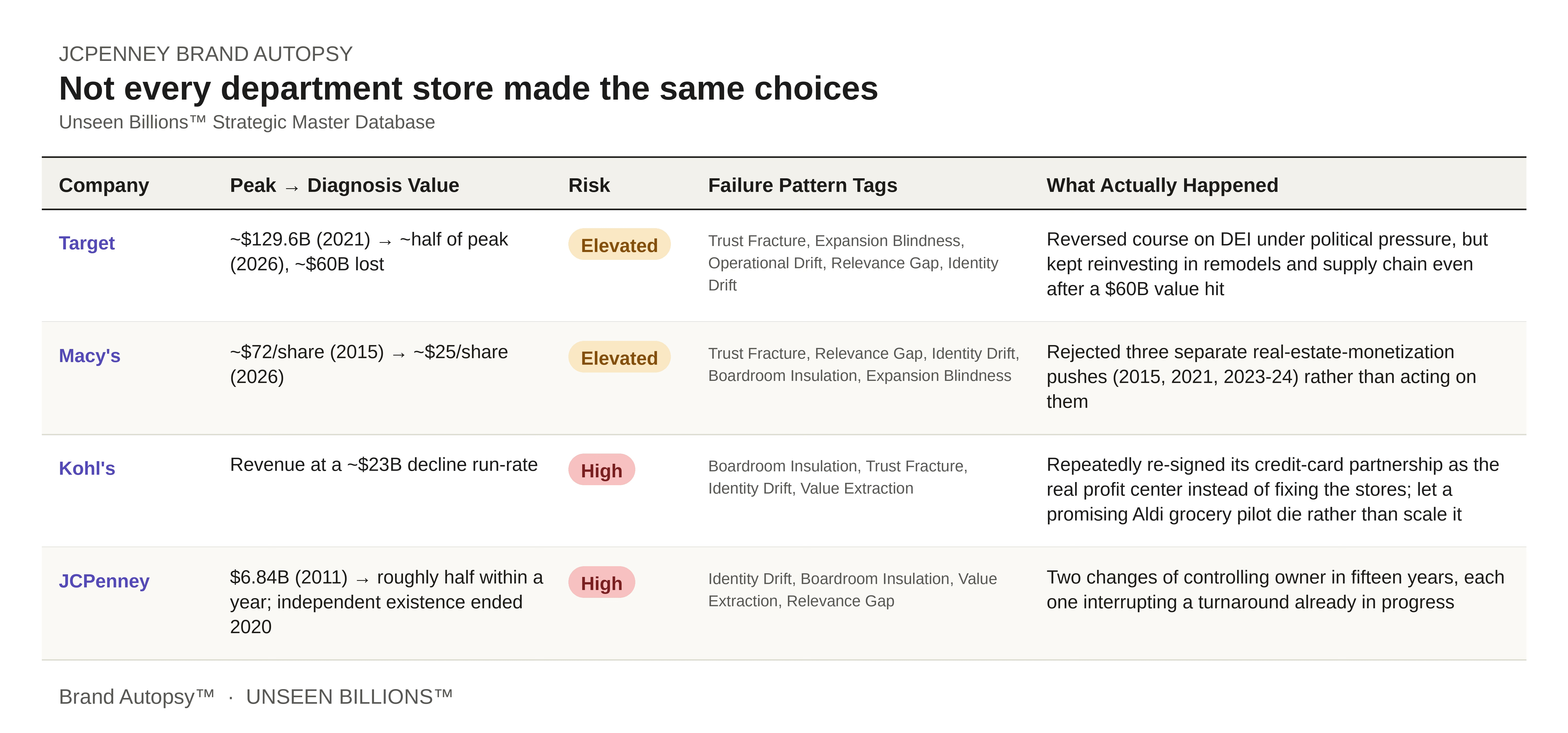
The lesson isn't "everyone in department stores struggled," because they did. It's that not everyone made the same choices in response. Target kept reinvesting through a $60 billion hit. Macy's board said no to real estate extraction three separate times, whether or not that was the right call. Kohl's leaned into its credit-card program instead of fixing the sales floor. JCPenney is the only one of the four that changed hands entirely, twice, with each new owner interrupting whatever recovery was already underway.
The Pattern, Named
An Activist and His Handpicked CEO. Bill Ackman didn’t run a department store. He ran a hedge fund that saw an undervalued asset and installed a leader with no loyalty to the culture he was reinventing. The buyback he orchestrated in 2011 raised the stock short-term while draining cash the company needed within two years. When it failed, he called it a disaster and moved on, $900 million lighter for JCPenney, a billion-dollar loss deeper.
The Landlords Who Became Owners. Simon Property Group and Brookfield spent decades collecting JCPenney’s rent. In 2020, they didn’t wait for an outside buyer to rescue the company. They bought it themselves, then folded it into a structure, Catalyst Brands, where JCPenney’s own former CEO now oversees it from above and its own part-owners collect rent and licensing fees regardless of whether the stores recover.
The Extraction. What actually got pulled out, concretely: a $900 million stock buyback in 2011 that weakened the company’s cash position ahead of its worst year. $11 million a year in royalty payments to a part-owner. Ongoing rent to landlord-owners. And, as of 2026, a $1 billion robotics investment by the same firm that owns half the parent company, funding the automation of the jobs inside JCPenney’s own supply chain.
The Consequences. A workforce that fell from 150,000 to 116,000 in a single reinvention year, and has kept shrinking since. A store count down from over 2,000 at peak to 641 today. A brand that a generation of shoppers, mine included, no longer even considers for something as basic as school shopping.
The Outcome. A company with a market cap of $6.84 billion in 2011 was worth roughly half that within a year, and hasn’t been an independent public company since 2020. It now exists as a demoted nameplate inside a six-brand holding company controlled by its own former landlords.
Here’s the question underneath all of it, the one nobody in this story ever actually answered: who is JCPenney for now? Ron Johnson answered “everyone except the coupon shoppers,” and lost the ones he had without winning anyone new. The financial owners answered “a portfolio of assets,” which isn’t an answer for a customer at all. And the customer answered with the only vote that actually counts: not me. A brand doesn’t collapse the moment it stops being profitable. It collapses the moment nobody in the building can answer who it’s actually for, and JCPenney has been unable to answer that question honestly for over a decade.
The Unseen Billions™ Diagnosis
JCPenney Brand Autopsy Score: 22/30 — High Structural Risk
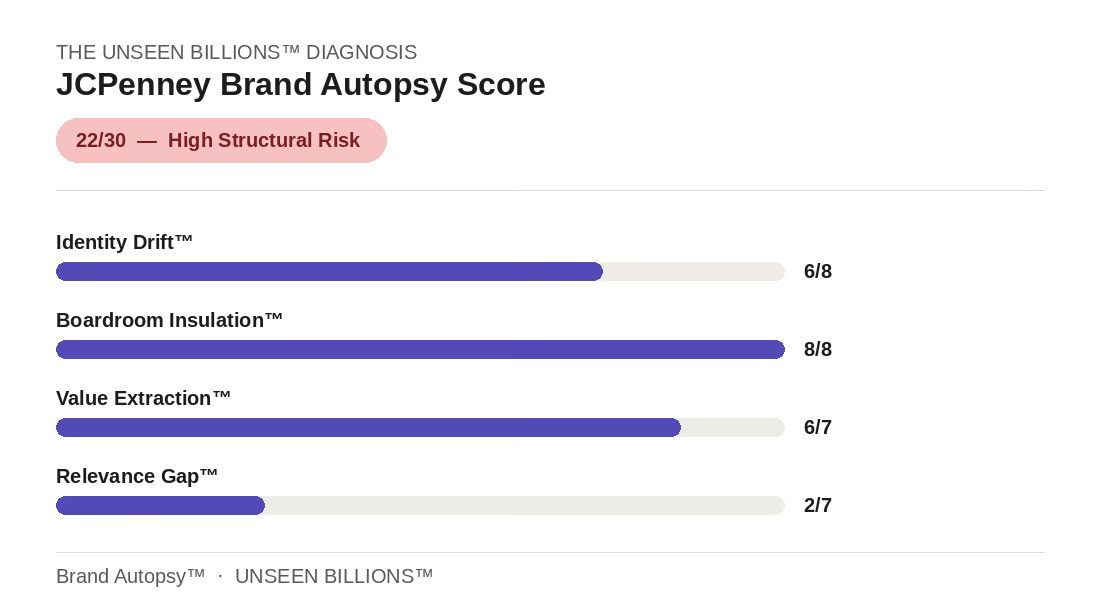
Identity Drift. JCPenney’s whole identity was built on one word: dependable. That identity survived a hundred years, then got overwritten twice in fifteen years, first by an executive who told loyal customers their coupons didn’t matter, then by a corporate structure that stripped JCPenney of its own CEO. The lesson: a brand can survive losing its excitement. It can’t survive losing the one thing it was actually known for.
Boardroom Insulation Ackman sat on the board that hired the CEO he wanted, then called the result a disaster only after the damage was irreversible. A decade later, JCPenney’s own landlords bought the company and built a structure where no independent party has to approve the rent they charge themselves. The lesson: when the people evaluating a decision have already made money on it regardless of outcome, “governance” stops being a real check.
Value Extraction. The 2011 buyback, the ongoing rent and royalty payments, and the Figure AI deal are three different mechanisms with the same effect: capital moves out of JCPenney toward the people who already own a piece of it, instead of into the stores or the workforce. The lesson: watch where the cash actually goes, not what the press release calls the move.
Relevance Gap. A generation of shoppers stopped considering JCPenney for anything, not because a single competitor took its place, but because nobody rebuilt a reason to walk in. The lesson: relevance doesn’t get taken from you all at once. It gets left unclaimed until somebody else picks it up.
In 1902, the question James Cash Penney answered was simple: treat every customer the way you’d want to be treated yourself. In 2026, the question nobody in this story has answered is different, and much smaller: who benefits from the structure built around the customer?
Coming in Part 2 and Part 3
Part 2 breaks down the actual money: fair-market rent, what the royalties really cover, and the terms of the Figure AI deal. Part 3 grades the prediction against Catalyst’s next disclosed numbers and checks whether the Sears test has been triggered.
Paying Subscriber Benefits
Annual paying subscribers get the following benefits:
Full access to the Unseen Billions™ archive, every published Brand Autopsy
The frameworks behind every autopsy: Cultural Displacement, Identity Drift, Relevance Gap, Trust Fracture, and Expansion Blindness
A weekly vote on which brand gets the next Autopsy
Monthly “Ask the Forensic Strategist” thread, where I answer subscriber questions on their own brand or category
Along with the above, Founding Members get:
A quarterly deep-dive request: submit a brand and it gets priority consideration for a future autopsy
A short written response on your own brand’s blind spots
Recognition as a Founding Member in the year-end Unseen Billions™ recap post
What This Means For Your Brand
If you’re reading this and quietly running the same math on your own company, rent structures, licensing fees, an ownership group with interests that don’t fully line up with the operating business, that instinct is usually right before it’s provable. Most boardrooms don’t find their own version of this story until an activist investor, a journalist, or a lawsuit finds it for them.
That’s the work I do at Editmybrand: forensic Brand Autopsies™ for CMOs, brand directors, and senior decision-makers at consumer brands doing $50M+ in North America and Scandinavia, built on the same five frameworks used in this piece, Identity Drift™, Boardroom Insulation™, Value Extraction™, Relevance Gap™, and Cultural Displacement™. I take on a small number of clients a month, by design, not volume. If you’d rather find your brand’s blind spot from me than from a headline, reach me at editmybrand@gmail.com.
Sources
JCPenney founding, April 14, 1902, Kemmerer, Wyoming; incorporated under Penney’s name 1913; NYSE listing 1927/1929 · Wikipedia (JCPenney; James Cash Penney); J.C. Penney Historic District, National Register of Historic Places; Library of Congress, “James Cash Penney: An Indefatigable Salesman”
Kemmerer as a coal mining town; mining company scrip system; cash-only, one-fixed-price model as a deliberate break from that system; local banker’s warning against it · WyoHistory.org; Cowboy State Daily (2023, two pieces); American Business History Center, “J.C. Penney, the Man: A Life of Perpetual Sharing”
1970s discount-store competition; 1980s reinvention as fashion/home retailer and HQ move to Plano, Texas; 2000-2001 crisis (43% profit drop, first outside CEO Allen Questrom, 48 stores closed, $705M loss); 2008 financial crisis impact · Encyclopedia.com (J.C. Penney Company history); Britannica Money; Library of Congress “This Month in Business History”
First department store format, 1961; 1970s peak of 2,000+ stores and $5B+ sales · Smithsonian National Portrait Gallery; Yahoo/Fast Company (2026)
Ackman’s $900M/17.8% stake, 2010; Ron Johnson hired 2011 at $53.3M first-year comp; 2011 $900M buyback · Forbes (2013); D Magazine, “Who Wrecked J.C. Penney?” (2013)
2012 results: 25% sales decline, $1B loss, stock down 51%, market cap $6.84B to $3.49B, employment 150,000 to 116,000 · NBC News (2013); Chief Executive (2013)
Johnson fired April 2013 after 17 months; Ackman’s “very close to a disaster” quote; Ullman rehired · CBS News/AP (2013); Forbes (2013)
2017 announcement of 138 store closures · contemporaneous retail trade reporting
846 stores in early 2020; May 2020 Chapter 11 filing; 242 planned closures (29%); one of two largest 2020 retail bankruptcies alongside Neiman Marcus · CBS News (2020); Statista
December 2020 emergence from bankruptcy; acquisition by Simon Property Group and Brookfield plus Authentic Brands Group · Axios (2025); Kiplinger (2025)
August 2023 self-funded $1B reinvestment plan; “starved for investment” quote; ~100 stores refreshed · JCPenney Newsroom (Aug 31, 2023); CBS News (2023); CoStar News (2023)
2025 “Yes, JCPenney” marketing campaign under CMO Marisa Thalberg; revenue trajectory $18B (2010) to $7.2B (2023) to $6.6B (FY2024, an 8.4% decline) · Forbes/Pam Danziger (June 27, 2025)
Macy’s Q4 comparable sales growth of 0.2% vs. JCPenney’s Q3 FY2024 sales decline of 8% · Yahoo Finance/Retail Dive coverage (March 2025)
January 2025 Catalyst Brands formation (JCPenney, SPARC/Authentic Brands Group, Simon Property Group, Shein); Marc Rosen promoted to Catalyst CEO; Michelle Wlazlo named JCPenney Brand CEO; Reebok US sale and Forever 21 strategic review · JCPenney Newsroom; The Robin Report (2025); Axios (2025)
FY2024 (ended Feb 2025) results: full-year net loss $177M, reversing a $30M prior-year profit; $11M in royalty payments to Authentic Brands Group · Retail Dive, “J.C. Penney swings to a loss” (May 2025)
Q3 FY2025 net loss widened 488% year-over-year to $100M · Retail Dive, “J.C. Penney’s loss balloons in Q3 as sales continue to slide” (Jan 13, 2026)
Q4 FY2025 (reported June 2026) results: net sales down 8%, net loss up 77% to $113M; full FY2025 net loss $173M · Retail Dive, “J.C. Penney rebound stalls in the holiday quarter” (2026); Home Textiles Today (June 2026)
Store count 641 as of mid-2026, down from 846 in early 2020 · Fast Company/Yahoo (June 2026); TheStreet (2025)
May 2026 Figure AI humanoid robot deployment at Catalyst’s Reno distribution center; Brookfield’s ~50% Catalyst ownership and lead role in Figure AI’s $1B Series C · Home Textiles Today (May 2026); Forbes (May 2026); Figure AI newsroom
Barnett Capital Advisors / Eric Moore motions alleging ~$5B transfer to Simon and Brookfield during 2020 bankruptcy; April 9, 2025 order withdrawing 34 bankruptcy cases including JCPenney over undisclosed judge-attorney relationship · PR Newswire (Feb 24, 2025; April 21, 2025) — note: allegations made in active litigation, not an adjudicated finding
Catalyst Brands corporate layoffs: 250 roles (5%) in early 2025, additional 9% cut roughly two months later; Forever 21 Reno/Sparks-area closure, 2025 · Retail Dive (April 2025); Nevada DETR WARN/Non-WARN registry
Target, Macy’s, and Kohl’s comparison figures (peak/diagnosis values, risk levels, failure pattern tags, strategic decisions) · Suz’s own Unseen Billions™ Strategic Master Database (Company Database tab), drawn from her previously published Target, Macy’s, and Kohl’s Brand Autopsies
JCPenney average customer age (51 in 2016) vs. Macy’s (49) and TJX (37); Kantar Retail survey · Forbes/Walter Loeb, “J.C. Penney Struggles With Its Aging Consumer” (2016)
Gen Z department-store shopper share (~6%) vs. ~40% Boomer customer base · Numerator research, cited in Forbes (2024)
YouGov brand-tracking “Consideration” score increase in 2025, driven by younger shoppers; Michelle Wlazlo’s “more than doubling” Gen Z/Gen Alpha consideration quote · YouGov, “Can JCPenney turn heads again?”; Forbes/Sharon Edelson, “JCPenney Pivots From Affordability Toward Fashion” (Sept 2025)
Target Corporation
$12.4B market value lost in weeks (2025 boycott) — The Charlotte Post (Mar 2025), Target stock data
2013 data breach, 40M card numbers stolen — NYT, Bloomberg Businessweek “Missed Alarms” (2014), krebsonsecurity.com
Q1 FY2026 sales beat but operating income/EPS declined YoY — Target Q1 FY2026 earnings release, via Unseen Billions Part 2 (Jul 14, 2026)
ROIC declining for multiple years — Unseen Billions Part 2 analysis (Jul 14, 2026)
March 2026 investment plan funded by Oct 2025 layoffs — Unseen Billions Part 2 analysis (Jul 14, 2026)
June 2026 annual meeting vote-against campaign against Cornell/Leahy — Target annual meeting results, via Unseen Billions Part 2
Macy’s, Inc.
$151M hidden delivery expenses (employee fraud) — Macy’s 8-K SEC filing; CNBC, CNN, NBC News (Nov 2024)
Rejected $24.80/share ($6.9B) buyout offer, Jul 2024 — AP, Reuters, CNBC, Arkhouse press releases
Website sells 2-3x more where a physical store exists — Macy’s executive statements, via Unseen Billions Part 2 (Jul 12, 2026)
$700M-$1.2B of online business “borrowed” from stores — author’s own calculation, Unseen Billions Part 2
Macy’s Media Network is 0.83% of revenue ($188M of $22.62B) — Macy’s official filings, via Unseen Billions Part 2
CFO Adrian Mitchell’s “not theft” quote, departed 4 months later — Retail Dive (Apr 2025), via Unseen Billions Part 2
UBS lone “Sell” rating through 90%+ rally — Investing.com analyst data, via Unseen Billions Part 2
Kohl’s Corporation
Credit-card profit share rose 23%→35% (2013-2016) — Federal Reserve Bank of Philadelphia, Credit Card Landscape Update (DP18-01)
Kohl’s doesn’t own the credit book, Capital One does — 2022 Kohl’s/Capital One partnership extension filing
20 years of credit-deal restructuring (2006 JPMorgan, 2011/2014/2022 Capital One) — Kohl’s Form 8-K (Mar 6, 2006)
Macellum activist group won 3 board seats over $7-8B real estate — Reuters/Yahoo Finance/US News (Nov 2022), Retail Dive (Mar 2021)
Card-to-Visa conversion issues (weak credit limits) — Annex Cloud (May 2025), Terry Savage column (Sep 2024)
BNPL reached $70B in 2025, diverting store-card spending — Federal Reserve Bank of Richmond, Economic Brief 26-05 (Feb 2026)
$129M one-time settlement flattered recent quarter — Kohl’s Form 10-Q (period ended Nov 1, 2025), SEC EDGARThis is a Brand Autopsy™, a forensic diagnosis of structural revenue leaks in major consumer brands, conducted through the Unseen Billions™ framework. Every claim above is drawn from public reporting and company disclosures. Not affiliated with, authorized by, or endorsed by JCPenney, Catalyst Brands, Brookfield, Simon Property Group, or Authentic Brands Group.
An extra that I'd like to add to the Ackman era was the plan for a new high-concept Penney, intended to be tested at its store at Valley View Center in Dallas. The plan with Valley View was to convert the upper floor into an experimental store to test everything from displays to sales strategies, with customers being in on it and presumably spreading word that "Penney is doing something new." Penney spent an unknown amount on this and never actually opened it, with the store being one of the 2013 casualties. As it was, Penney shutting down was what ultimately helped kill Valley View and not the other way around: by 2012, most of the mall had been converted to artist galleries (I had a gallery there between 2015 and 2017, when the majority of the mall closed down), and they received significant traffic because of customers for Penney and for the big Foot Locker store at the other end of the mall. (In 2016, the mall's owner opened up the long-shuttered Penney store to sell off everything left behind, and the amount of money left on displays, including high-tech mannequins, was just absolutely stunning. Almost everything was selling for pennies on the dollar just to get it out of the space, most were still in their original packaging, and apparently Penney thought it better to leave all of it in the space because it wasn't worth the bother to ship and store it elsewhere.) In the end, not only was the experimental store a factor in that individual store closing, but the decision to pull the plug on further innovations was what killed the rest of the mall, and all of the other stores shut down at the same time.
Growing up in the 70s and 80s JC Penny’s was definitely back to shopping for my mom.